

Why Choose Heat Sealing Cover Tape for Packaging?
Packaging lines rarely fail dramatically; they drift. A cover tape may look acceptable, yet poor sealing can expose components to dust, moisture, or handling damage. Heat Sealing Cover Tape offers a controlled bond between the carrier pocket and the protective tape. It is widely used for electronic components, small hardware, and other precision parts. The practical appeal is simple: heat activates the adhesive, creating a consistent seal when temperature, pressure, and dwell time are properly managed. Small details matter.
From production experience, reliable results begin with matching tape construction to the carrier material. Polycarbonate, polystyrene, and embossed materials can respond differently to heat. A line operator may notice edge lifting before inspection equipment detects it. That warning should not be ignored. Seal strength, peel performance, clarity, and antistatic behavior deserve documented checks. Test samples should run through the actual sealing head, speed, and storage conditions. Laboratory data helps, but the factory floor tells the fuller story. Sometimes, assumptions fail.
Choosing Heat Sealing Cover Tape can improve product protection, presentation, and process repeatability, but it is not a universal answer. Excessive heat may deform pockets or stress sensitive components. Insufficient heat may produce a weak seal that opens during transport. Qualified suppliers should provide technical data, application guidance, and traceable quality controls. Buyers should also review compatibility, recycling goals, and operator safety before approval. The best decision comes from measured trials, not attractive claims. A careful evaluation may reveal that another sealing method fits better. That is useful knowledge, not failure.
What Is Heat Sealing Cover Tape?
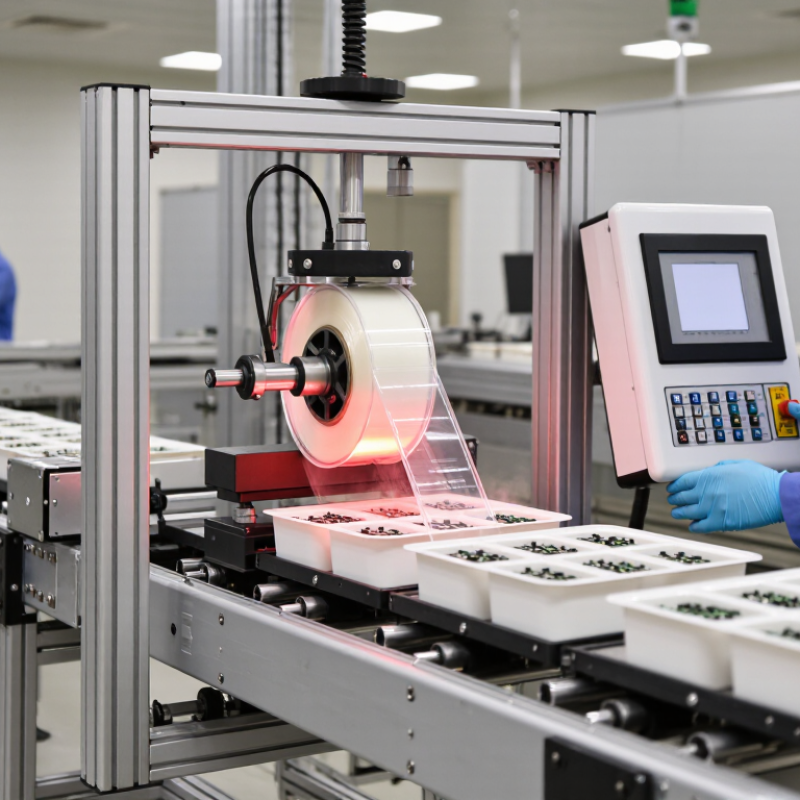
Heat sealing cover tape is a protective film used to close pockets in carrier tapes. It keeps electronic components inside during transport, storage, and automated assembly. The tape usually combines a clear polyester or polycarbonate carrier with a heat-activated adhesive layer. When heated, the adhesive softens and bonds to the carrier tape’s sealing surface. After cooling, it forms a controlled seal without liquid glue. That small difference matters.
In practice, an operator sets temperature, pressure, and dwell time on the sealing equipment. The correct settings depend on tape structure, carrier material, pocket design, and line speed. A stable seal should resist vibration while still allowing clean peeling at the placement machine. Too much heat may deform pockets or leave adhesive residue. Too little heat can create weak edges and accidental openings. We have found that visual inspection alone is not enough. Peel-force checks and sample runs reveal problems earlier.
Good cover tape can also support product visibility, static control, and reliable feeding. A transparent film lets technicians inspect component presence without opening the package. Anti-static options may reduce charge buildup around sensitive parts, but they require proper verification. Storage conditions matter too. Humidity, dust, and prolonged heat can change sealing performance. One overlooked issue is compatibility: a tape may seal well today but peel poorly after aging. Testing across real storage and production conditions gives more trustworthy results.
Why Choose Heat Sealing Cover Tape for Packaging? - What Is Heat Sealing Cover Tape?
| Data Dimension | Typical Information | Packaging Significance |
|---|---|---|
| Product definition | A roll of flexible cover tape designed to seal the opening of a carrier tape after electronic components are loaded. | It helps retain components during storage, transport, and automated pick-and-place handling. |
| Sealing principle | Heat activates a sealant layer on the cover tape, which bonds to the compatible sealing surface of the carrier tape. | The seal can be opened by controlled peeling while maintaining sufficient holding force for normal handling. |
| Common layer structure | Typically includes a transparent or translucent support film, a functional coating or adhesive layer, and a heat-sealable layer. | The multilayer design balances mechanical strength, clarity, seal performance, and peel behavior. |
| Frequently used film materials | Polyester-based films are common for dimensional stability; polypropylene and polyethylene-based sealant layers may be selected for compatibility with the carrier tape. | Material selection should match the carrier tape, sealing equipment, component sensitivity, and required peel force. |
| Typical sealing temperature | Common process settings are approximately 100–180 °C, depending on the tape construction, carrier material, dwell time, and equipment. | The exact setting must be established through process trials because excessive heat can deform the carrier tape or affect sensitive components. |
| Seal initiation temperature | Often approximately 80–130 °C for heat-sealable constructions, although the actual value varies by sealant chemistry and test method. | A lower seal initiation temperature can support shorter cycle times and reduce thermal exposure when the material system permits it. |
| Peel behavior | Designed to provide a controlled peel force rather than a permanent bond. Typical requirements are application-specific and should be verified by testing. | Consistent peeling helps automated equipment access components without excessive shock, residue, or tape tearing. |
| Transparency | Many cover tapes are transparent or translucent, with optical performance determined by the film and coating design. | Visibility can assist visual inspection of component position, tape loading, and contamination before the reel enters production. |
| Electrical protection options | Some constructions are available with static-dissipative or antistatic properties; performance depends on the complete packaging system. | Electrostatic-control requirements are important for electronic components that may be damaged by electrostatic discharge. |
| Dimensional stability | A stable support film helps limit shrinkage, stretching, curling, and wrinkling during sealing and storage. | Stable dimensions support accurate indexing and reduce the risk of poor sealing or interference with feeder operation. |
| Main application | Sealing embossed or pocketed carrier tape used for surface-mount devices, integrated circuits, connectors, sensors, and other small components. | The format supports reel-based storage and high-speed automated component feeding. |
| Key advantages | Secure component retention, controlled opening, good visibility, compatibility with automated sealing, and efficient reel packaging. | These features can help improve handling efficiency and reduce component loss during logistics and assembly. |
| Important limitations | Performance may change with humidity, contamination, sealing pressure, temperature, dwell time, carrier-tape material, and storage conditions. | Process validation is necessary to prevent weak seals, excessive peel force, adhesive residue, wrinkles, or carrier deformation. |
| Recommended quality checks | Inspect seal continuity, peel force, tape alignment, appearance, residue, dimensional stability, and component retention after sealing. | Routine checks help maintain consistent feeder performance and confirm that the cover tape is suitable for the complete packaging process. |
Note: Temperature ranges and performance values are typical industry guidance only. Final settings and specifications should be confirmed through testing with the selected carrier tape, cover tape, components, and sealing equipment.
Exclusive Access
Unlimited Resources
Detailed information on our products to assist you with the planning of your cable management project
Register Now
BIM Files

Step Files

Installation Manuals

User Guides

Best Practice Guides
