China Best Advertising Flag Pole Manufacturer for Global Buyers
Outdoor advertising still earns attention in crowded streets, retail entrances, and event spaces. The Out of Home Advertising Association of America reported that U.S. out-of-home advertising revenue reached $9.1 billion in 2023, up 2.1% year over year. This figure covers the wider out-of-home sector, not Advertising Flags alone. Still, it shows why physical visibility remains relevant to global brands.
An Advertising Flag can put a logo or short message at eye level, where movement and wind help draw attention. But visibility depends on more than a printed design. Fabric weight, stitching, pole flexibility, base stability, and print consistency all affect performance in real conditions. Small details matter. A weak connector may fail before the fabric does.
For global buyers, choosing a manufacturer means checking samples, material specifications, production controls, and packaging suited to shipping and storage. Ask how the supplier tests color consistency and handles repeat orders; clear answers are more useful than broad promises. Industry data can inform the opportunity, but it cannot guarantee campaign results. That part deserves honest expectations. This guide examines what buyers should assess when comparing China-based Advertising Flag Pole manufacturers, including product quality, customization, communication, and practical support after delivery. A low price may look attractive on a quotation, yet become less convincing when durability or color accuracy falls short. The right supplier is not always the cheapest. It is the one whose claims can be checked.
Advertising Flag Poles: Formats, Uses, and Common 3–6 m Heights
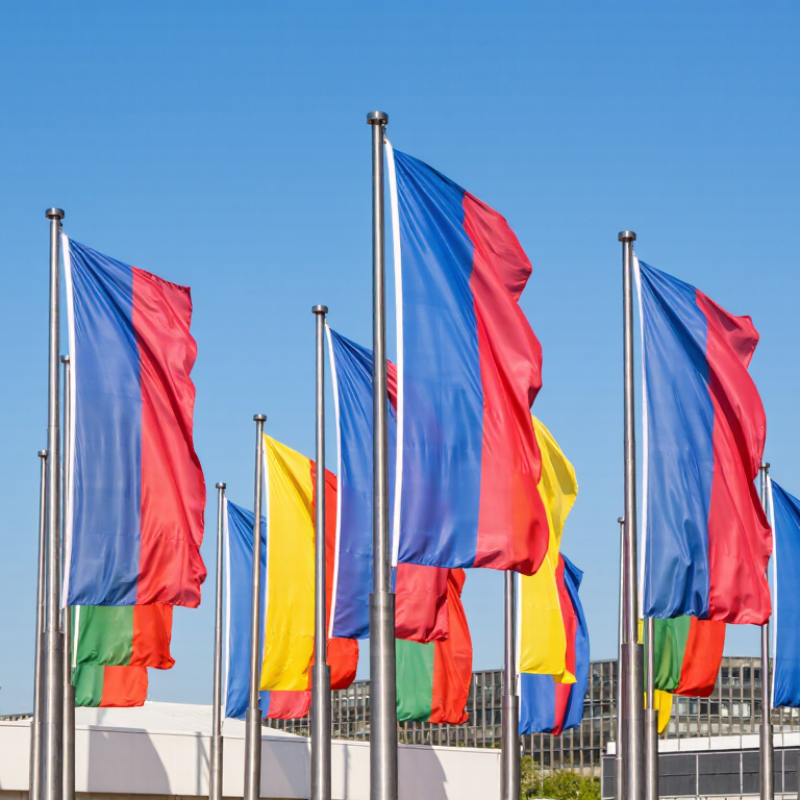
Advertising flag poles are commonly paired with feather, teardrop, and rectangular flags. Feather shapes give a tall, flowing profile beside shop entrances or event paths. Teardrop flags hold their outline more steadily when the wind eases. Rectangular flags offer a broader area for short messages, though their fabric can fold over in gusts. Small details matter.
Heights from 3 to 6 metres are common, but the right size depends on the site. A 3-metre pole may suit a pavement display or indoor exhibition, while a 5- or 6-metre pole can improve visibility in an open forecourt. Check ceiling height, nearby branches, overhead clearances, and the base surface before choosing. On exposed sites, a taller flag may move more and need closer attention. There is no perfect height for every location; even a well-planned display can look crowded beside signs or doors. Match the flag format, pole height, and base to the space, then review the setup after installation.
Advertising Flag Poles: Formats, Uses, and Common 3–6 m Heights
Common pole heights shown in meters, with approximate feet conversions.
Feather, teardrop, and rectangular flags are used for storefronts, events, and outdoor promotions. The 3–6 m range covers commonly encountered pole heights; the best choice depends on the flag format, site clearance, wind exposure, and venue requirements.
Flag Fabrics: Comparing 110–130 GSM Polyester and Print Methods
For advertising flags, 110–130 GSM polyester covers a useful range, but fabric weight alone does not predict service life. A 110 GSM knit is lighter and tends to move readily in a gentle breeze. It can suit frequent displays and vivid motion. A 130 GSM option feels fuller and may resist handling wear better, though yarn quality, knit structure, stitching, and exposure matter just as much. Heavier fabric is not always the better choice.
Print method affects both appearance and production fit. Dye sublimation is widely used on polyester: heat transfers the color into the fibers, producing smooth gradients and detailed graphics. On single-layer fabric, the image may show through to the reverse, usually with softer color. Screen printing can work for simpler designs and larger runs, but fine gradients are less practical. Ask for a printed sample, not just a color chart. Small differences show.
Check the fabric under real light and inspect the seams near the pole sleeve and corners. These areas often experience repeated pulling. A heavier cloth may hang nicely, yet flap less in light wind; that can change how an advertisement reads from a distance. I would compare samples outdoors before choosing. This step is easy to skip, and sometimes that is a mistake.
Pole Materials and Construction: Aluminum, Fiberglass, and Stainless Steel
China Best Advertising Flag Pole Manufacturer for Global Buyers
Pole Materials and Construction: Aluminum, Fiberglass, and Stainless Steel
Material choice affects a flagpole’s weight, corrosion resistance, maintenance, and installation cost. Aluminum is a practical option for many commercial sites because it is light and easy to handle. The International Aluminium Institute reports that recycling aluminium uses about 5% of the energy required to produce primary aluminium. That supports its circularity, but buyers should still check alloy grade, wall thickness, and finish. Thin sections may flex noticeably in gusty locations.
Fiberglass resists rust and does not conduct electricity like metal, making it useful near coastal air or sensitive equipment. Its performance depends on resin, reinforcement, UV protection, and workmanship. Inspect joints and surface condition; damage can be less obvious than on a metal pole. Field conditions matter. Stainless steel offers strength and strong corrosion resistance, but it is heavier and can raise transport and foundation requirements. World Stainless reports an average recycled content of about 60% for stainless steel.
No material wins everywhere. A tall pole in an exposed plaza needs different engineering from a short pole beside a building. Ask suppliers for wind-load assumptions, material specifications, and connection details, not just a height and price. One detail is easy to miss: fittings, base plates, and anchors must suit the pole and site. A good specification still needs local engineering review.
Wind-Load Design: q = 0.613V² N/m² for Site-Specific Safety
China Best Advertising Flag Pole Manufacturer for Global Buyers
Wind-Load Design: q = 0.613V² N/m² for Site-Specific Safety
For an advertising flag pole, wind pressure is a practical starting point, not a complete design answer. In q = 0.613V², V is wind speed in metres per second. At 20 m/s, the reference pressure is about 245 N/m². A flag catches wind like a flexible sail, so its size, fabric, height, and mounting details affect the forces transferred to the pole. Local exposure matters too. A sheltered courtyard and an open coastal site should not share assumptions.
Tips: Confirm the design wind speed for the exact site. Check the flag area, pole height, base, and anchors together. Ask for the calculation basis.
A reliable specification considers gusts, terrain, pole material, and foundation capacity—not pressure alone. Installation also deserves attention: loose anchors or a poorly levelled base can undermine sound calculations. Small details count. After storms, inspect fittings for movement, corrosion, or cracks, and record what you find. Real sites can behave differently from neat calculations; that gap is worth reviewing with a qualified structural professional before production.
| China Best Advertising Flag Pole Manufacturer for Global Buyers - Wind-Load Design: q = 0.613V² N/m² for Site-Specific Safety |
| Wind Speed (m/s) | Wind Speed (km/h) | Calculated Dynamic Pressure, q (N/m²) |
| 10 | 36 | 61.3 |
| 15 | 54 | 137.9 |
| 20 | 72 | 245.2 |
| 25 | 90 | 383.3 |
| 30 | 108 | 551.7 |
| 35 | 126 | 750.9 |
| 40 | 144 | 980.8 |
| 45 | 162 | 1,241.3 |
| 50 | 180 | 1,532.5 |
| Calculation: q = 0.613V², where V is wind speed in metres per second. Values are rounded to one decimal place; 1 N/m² equals 1 Pa. These are reference dynamic-pressure values, not final flag-pole design loads. Site-specific design should account for applicable local codes, exposure, gust effects, pole geometry, flag area, and structural response. |
Factory Quality Tests: ASTM D5034 Strength and ISO 105-B02 Lightfastness
For advertising flag fabric, strength and color retention affect how a flag performs after repeated handling and sun exposure. ASTM D5034 measures textile breaking strength using a grab test. In practical terms, a laboratory grips a defined fabric area and pulls until it breaks. The recorded force helps compare material samples, but it does not predict every seam, stitch, or finished flag’s performance.
ISO 105-B02 evaluates color fastness to artificial light, commonly using a xenon-arc source to simulate sunlight. Exposed specimens are compared with reference materials, including blue wool standards, to assess fading. This matters when a flag hangs outdoors for long periods. A vivid sample may still fade faster under intense sun, heat, or moisture. Test conditions matter.
Buyers can ask for dated reports that identify the fabric, test method, specimen direction, and results. Check that the tested material matches the production order, not just a similar sample. A report is useful evidence, not a promise of a fixed service life. Even sound testing has limits; local weather and installation can change the outcome. That point is easy to overlook.


