Main menu Open search

Blog

China Top Powder Coating Equipment Manufacturers

China has become a significant production base for industrial finishing systems, including powder application, curing, and recovery technologies. This article examines China’s top Powder Coating Equipment manufacturers through practical and technical criteria. The focus is not only factory size or export volume. It also considers coating consistency, transfer efficiency, automation, energy use, safety design, and after-sales support.

Market reports show why this sector deserves careful attention. Grand View Research reported that the global powder coatings market was valued at approximately USD 12.9 billion in 2023, with continued growth expected through 2030. MarketsandMarkets also forecasts steady expansion, driven by solvent reduction, environmental requirements, and demand from automotive, appliance, construction, and metal-furniture industries. These reports describe coating materials rather than equipment alone, but they clearly indicate rising demand for reliable production lines. Performance matters.

Leading Chinese manufacturers commonly supply electrostatic spray guns, automatic reciprocators, spray booths, cyclone or cartridge recovery units, curing ovens, and integrated control systems. A serious evaluation should examine powder usage per workpiece, voltage stability, oven temperature uniformity, booth cleaning time, and spare-parts availability. Factory testing is valuable. Ask for measured results, not attractive brochures.

Manufacturers may present similar specifications, yet field performance can differ considerably. A low initial price may conceal higher powder waste or difficult maintenance. Certification claims should also be verified against the actual model and destination-market requirements. No ranking is permanently correct. This guide therefore combines published market evidence, equipment knowledge, manufacturer documentation, and realistic buyer concerns. The goal is a dependable starting point for comparing China’s leading suppliers, while recognizing that application conditions can change the final decision.
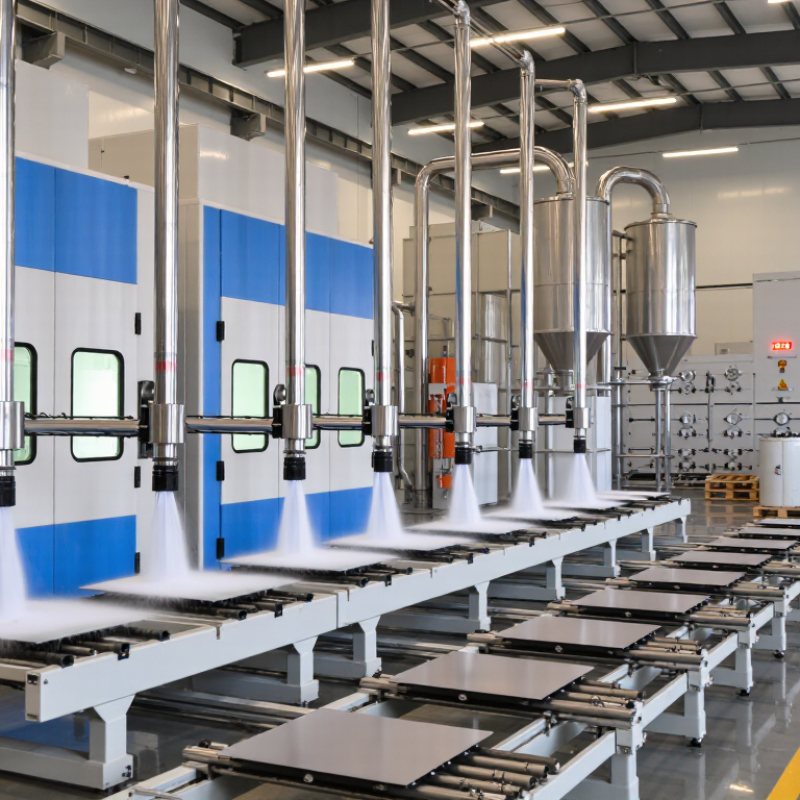
China Top Powder Coating Equipment Manufacturers

What Is Powder Coating Equipment?

China Top Powder Coating Equipment Manufacturers

What Is Powder Coating Equipment?

Powder coating equipment is a coordinated system for applying and curing dry polymer powder on metal surfaces. It normally includes a spray gun, powder hopper, control unit, booth, recovery filter, oven, and conveyor. The gun charges powder particles electrostatically. The particles then cling to a grounded workpiece before entering the curing oven. Heat melts and cross-links the powder into a continuous protective film.

Typical curing temperatures range from 160°C to 200°C, depending on the powder formulation and substrate. Proper airflow matters. Uneven temperature can create orange peel, weak adhesion, or under-cured areas. Grand View Research reported that the global powder coatings market was valued at approximately USD 14.45 billion in 2023. Its report also projects continued growth through 2030. Other industry reports provide different figures, so market estimates should be checked carefully before planning capacity.

Tips: Match the oven size to the largest workpiece, not the average one. Check temperature uniformity with data loggers. Keep booth filters clean. A small grounding fault can cause unstable transfer efficiency. In practical production, operators often focus on gun settings and overlook pretreatment. That is a mistake. Clean metal and consistent film thickness remain more important than impressive equipment specifications. Test samples before full production, because real workshop conditions rarely behave perfectly.

How China’s Powder Coating Equipment Industry Has Developed

China Top Powder Coating Equipment Manufacturers

China’s powder coating equipment industry has shifted from basic fabrication to integrated, data-supported production. Earlier systems often relied on manual feeding, fixed settings, and limited process records. Today, manufacturers increasingly develop automatic powder rooms, precision dosing units, curing ovens, and recovery systems.

This change follows wider industrial automation. The International Federation of Robotics reported that China installed 276,288 industrial robots in 2023, representing more than half of global installations. That capacity supports faster equipment development and stronger component supply chains. Grand View Research estimated the global powder coatings market at about 15 billion US dollars in 2023, with continued growth expected through 2030. Demand for lower-emission finishing methods has encouraged investment, especially in appliances, furniture, transportation, and construction equipment.

However, development is uneven. Not every factory needs a fully automated line. Some systems still struggle with color-change waste, powder recovery accuracy, and uneven oven temperatures. These weaknesses deserve honest testing, not impressive brochures. Field experience shows that stable airflow and grounded workpieces often matter more than complicated software.

Tips: Check coating thickness at several points. Record oven temperature beside the workpiece. Ask for recovery-efficiency data under real production conditions. Also, compare energy use per coated square meter, not only purchase price. Industry reports provide direction, but factory trials reveal the practical truth.

China Powder Coating Equipment Industry Development, 2018–2023

China’s growing powder coating output has supported the development of local equipment manufacturing. Rising demand from construction, appliances, automotive components, and general industrial applications has encouraged suppliers to improve automated spraying, curing, recovery, and production-line integration technologies.

Data source: Rounded annual industry estimates reported by the China National Coatings Industry Association and related industry publications. Values represent China’s powder coating output, not individual company sales.

Main Types of Powder Coating Equipment from Chinese Manufacturers

Chinese manufacturers supply several main types of powder coating equipment for different production scales and product shapes. Spray booths capture overspray and protect nearby surfaces. Manual spray guns suit small batches, prototypes, and frequent color changes. Automatic spray systems provide steadier coverage on cabinets, frames, and metal panels. Their performance depends on gun positioning, powder flow, and conveyor speed.

Curing ovens melt and bond the powder onto the workpiece. Electric, gas, and infrared heating options serve different factory layouts. A well-designed oven should maintain even temperature from front to back. Poor airflow can leave dull patches or weak coating adhesion. Recovery units collect unused powder, reducing material waste during suitable production runs. Conveyors connect loading, spraying, curing, and unloading stations. Some factories need simple overhead rails, while others require programmable systems. In practice, specifications often look better than results. Trial testing remains essential.

Tips: Ask for coating trials using your actual metal parts. Check temperature uniformity at several oven positions. Measure transfer efficiency, noise, cleaning time, and compressed-air use. Request operating manuals, maintenance schedules, and training support. Keep spare filters and inspect grounding points regularly. A cheaper system may become expensive when color changes take too long. Never judge equipment by appearance alone. The first sample may pass, but repeated testing can reveal uneven edges or unstable powder flow.

Key Features to Compare Among Chinese Equipment Suppliers

When comparing Chinese powder coating equipment suppliers, examine performance data rather than brochure language. Grand View Research valued the global powder coatings market at approximately USD 13 billion in 2023. That growth increases pressure on coating lines to deliver stable output, not merely attractive pricing.

Check booth airflow, powder recovery, and transfer efficiency under your actual powder formulation. Ask for test panels showing film thickness, adhesion, gloss, and color consistency. The curing oven deserves close inspection. Measure temperature uniformity at several points, because an impressive setpoint can hide uneven curing. Energy consumption should be recorded per coated square meter, not only per hour.

Automation is another practical dividing line. Compare PLC functions, alarm records, recipe storage, and remote diagnostic limits. Operators need clear screens and quick adjustments. Safety documentation should cover ventilation, grounding, electrical protection, and routine cleaning. ISO 9001 certification can support process control, but it cannot replace factory acceptance testing.

That distinction matters. A supplier may provide excellent equipment, yet deliver weak commissioning support. Request spare-parts lists, response times, installation training, and references from similar production environments. The Powder Coating Institute emphasizes proper pretreatment, application, and curing as connected quality factors. Therefore, judge the complete line, not the spray gun alone.

One detail is easy to miss. Test powder recovery with several colors and particle distributions. Reclaim performance may change noticeably. A small trial often reveals more than a confident sales presentation. Industry experience still has limits, and supplier claims require verification.

How to Select a Reliable China Powder Coating Equipment Manufacturer

China Top Powder Coating Equipment Manufacturers

Selecting a reliable China powder coating equipment manufacturer requires evidence, not attractive photographs. Fortune Business Insights valued the global powder coatings market at USD 15.58 billion in 2023. It projects USD 22.89 billion by 2032. This growth increases equipment demand, but quality can vary sharply between suppliers.

Request a factory audit or live video inspection. Check welding quality, electrical cabinets, grounding, airflow, and powder recovery seals. Ask for test panels using your actual powder and workpiece dimensions. Measure coating thickness, curing uniformity, transfer efficiency, and color consistency. A credible manufacturer should provide calibration records, equipment drawings, and traceable component lists. ISO 9001 certification helps, but it does not replace technical verification.

Review installation support, spare-part availability, training, and response times. Ask for references from factories with similar throughput. A low quotation may hide weak insulation, limited controls, or expensive replacement parts. That assumption is risky. I would also compare energy data, because curing ovens often dominate operating costs. The U.S. Department of Energy identifies industrial process heating as a major energy-use area, making oven efficiency commercially important. Do not accept vague promises. Require written performance criteria, acceptance testing, warranty terms, and clear responsibility for commissioning. Perfect documentation is rare, but missing documentation deserves careful reflection.

China Top Powder Coating Equipment Manufacturers - How to Select a Reliable China Powder Coating Equipment Manufacturer

A practical comparison framework for evaluating powder coating equipment suppliers, systems, documentation, safety, service and total cost of ownership.

Evaluation Dimension What to Check Recommended Benchmark or Requirement Evidence to Request Priority Suggested Weight
Application Fit Workpiece size, material, geometry and production mix The supplier should size the booth, oven, conveyor and gun configuration according to the largest part, coating chemistry, required film thickness and daily production volume. Written technical proposal, layout drawing, process flow and assumptions used for sizing. High 15%
Powder Application Gun control, voltage/current adjustment and powder delivery The system should provide adjustable electrostatic parameters and stable powder feeding for the intended powder type and application method. Equipment datasheet, control-panel specifications, operating range and test results on representative parts. High 10%
Transfer Efficiency Powder utilization and overspray recovery Ask how overspray is collected, filtered and returned or disposed of. Recovery arrangements must be compatible with the powder chemistry and color-change requirements. Process description, recovery-system diagram, powder consumption assumptions and color-change procedure. High 10%
Curing Oven Temperature uniformity, heating method and residence time The oven should achieve the powder manufacturer’s specified metal-temperature cure schedule throughout the usable work zone, not merely the displayed air temperature. Temperature-mapping method, oven profile, insulation details, burner or heater specifications and commissioning report. High 15%
Pretreatment Cleaning, rinsing, chemical treatment and drying Pretreatment stages should match the substrate and corrosion-performance target. Water quality, chemical concentration and bath maintenance should be controllable. Process-stage diagram, tank materials, pump specifications, chemical-control plan and wastewater responsibilities. High 10%
Booth and Filtration Airflow, containment, filtration and cleaning access The booth should control powder escape, maintain suitable airflow and allow practical filter inspection and replacement. Automatic cleaning is useful for frequent color changes. Airflow calculations, filter model and quantity, pressure-drop data, booth drawings and cleaning cycle description. High 10%
Explosion and Fire Safety Combustible powder risk, ignition control and electrical protection Powder coating systems must be designed around combustible-dust hazards. The supplier should address grounding, bonding, ventilation, ignition-source control and applicable local regulations. Hazard assessment, grounding plan, safety interlocks, electrical-area classification and conformity documentation required for the destination country. High 15%
Grounding Workpiece, hanger, conveyor and operator grounding Effective grounding is essential for electrostatic application and safety. The supplier should define inspection points and acceptable resistance limits according to the applicable standard and system design. Grounding diagram, inspection procedure, test instrument recommendation and commissioning records. High 5%
Controls and Automation PLC, alarms, recipe management and data access Controls should provide clear alarms, process monitoring, recipe storage and safe restart behavior. Interfaces should be available in the required language. Control architecture, alarm list, HMI screenshots, backup procedure and user-access levels. Medium 5%
Energy Consumption Oven fuel or electrical demand, booth fans and compressed air Compare energy consumption using the same production assumptions. Heat recovery, insulation quality and correctly sized fans can materially affect operating cost. Rated power, fuel-consumption estimate, compressed-air demand and calculation basis at the proposed throughput. Medium 5%
Quality Assurance Manufacturing controls, inspection and traceability A reliable supplier should have documented design review, incoming inspection, weld-quality control, electrical testing and final inspection procedures. Quality manual summary, inspection and test plan, calibration records and sample factory-acceptance checklist. High 5%
Compliance Documents Standards and destination-market requirements Required documentation depends on the destination, electrical system, machine configuration and hazardous-area assessment. Do not treat a generic certificate as proof of full system compliance. Declaration of conformity where applicable, electrical schematics, manuals, risk assessment and component certificates. High 5%
Testing and Acceptance Factory acceptance test and site acceptance test Acceptance criteria should be agreed before the purchase order, including output, cure performance, coating appearance, alarms, safety functions and documentation. Signed FAT/SAT protocol, test-piece requirements, measurement methods and rejection or correction procedure. High 5%
Installation Support Mechanical installation, electrical connection and commissioning Clarify which party provides foundations, utilities, lifting equipment, local electricians, ventilation connections and production start-up support. Installation responsibility matrix, utility list, site-preparation guide and commissioning schedule. Medium 5%
After-Sales Service Remote support, response time and spare-parts availability The supplier should provide a defined support channel, troubleshooting process, recommended spare-parts list and realistic response commitments. Service-level terms, escalation contacts, spare-parts quotation, warranty conditions and training plan. High 10%
Supplier Verification Production capability and financial or operational stability Verify that the supplier designs and integrates the proposed system rather than only reselling unrelated components. Check whether its facilities and engineering resources match the project scale. Factory audit, organization overview, engineering-team information, production photos, inspection records and references for comparable applications. High 10%
Commercial Terms Scope, delivery terms, payment schedule and exclusions The quotation should separate equipment, optional items, installation, commissioning, training, packaging, freight, taxes and local compliance work. Itemized quotation, technical annex, delivery schedule, warranty terms and list of exclusions. High 10%
Total Cost of Ownership Purchase price plus energy, consumables, labor and maintenance Evaluate the system over its expected service life rather than selecting solely on initial price. Include filters, heaters, guns, pumps, seals, downtime and planned maintenance. Five-year or project-life cost model with stated assumptions and replacement intervals. High 10%
Color-Change Capability Cleaning time, reclaim arrangement and cross-contamination control For multi-color production, assess booth design, gun cleaning, hose replacement, powder recovery and waste handling. The best configuration depends on color frequency and product mix. Documented color-change sequence, estimated labor time, cleaning tools and powder-loss assumptions. Medium 5%
Documentation and Training Manuals, drawings, maintenance instructions and operator training Documentation should be supplied in the required language and include electrical drawings, spare-parts identification, safety procedures and preventive-maintenance intervals. Sample manual, as-built drawings, training agenda, maintenance checklist and document-delivery schedule. Medium 5%
Selection Method: Score each supplier from 1 to 5 for every applicable criterion, multiply the score by the suggested weight, and verify all high-priority safety and compliance items before comparing price. Technical suitability and documented evidence should take precedence over marketing claims.

Exclusive Access

Unlimited Resources

Detailed information on our products to assist you with the planning of your cable management project

Register Now

BIM Files

Step Files

Installation Manuals

User Guides

Best Practice Guides

Technical Charts